
GPT-6 Cyber in 2026: How OpenAI’s New Security Model Is Changing Cybersecurity
Table of Contents
- What Is GPT-6 Cyber?
- Why OpenAI Rates It Critical
- What It Has Already Found
- How It Stays Within Scope
- Who Can Use It, and How Access Works
- The Safeguards Around It
- What It Means for Your Business
- Risks and Honest Limitations
- Your 10-Step Checklist
- Expert Tips and Best Practices
- Common Mistakes to Avoid
- Conclusion
- Frequently Asked Questions
Introduction
Your next software update may arrive because an AI found 81 flaws your vendor had missed. That is not a prediction. It is what happened when OpenAI turned its newest security model loose on Firefox — and it is why GPT-6 Cyber matters to you even though you will probably never use it yourself.
OpenAI announced GPT-6 Cyber on November 5, 2026, and gave it a “Critical” rating for cybersecurity, the highest level in its Preparedness Framework. In plain terms, OpenAI believes this model is powerful enough to change how security work gets done, and risky enough that only approved defenders should touch it. This guide explains what it is, what it has already found, who can use it, and — most useful for most readers — what your business should do this week, whether or not you ever get access.
Here is the one-line version: GPT-6 Cyber is a specialised tool for authorised security research. It finds flaws, proves they are real by building working exploits, and helps write fixes. It is not a general chatbot, it is not open to the public, and it will not make your business secure on its own. What it does change is speed — finding and proving flaws used to take humans hours or days each. Now it can happen at a scale that fills a vendor’s patch list overnight. Your job is to be ready for that faster patch cycle.
What Is GPT-6 Cyber?
A specialist, not a chatbot
GPT-6 Cyber is a specialised version of OpenAI’s GPT-6 Astra model, built for one job: cybersecurity research. Give it a target — software, a web app, or a codebase — and it works as an agent. It reads the code, probes the software, hunts for weaknesses, and tries to turn a suspected flaw into a working exploit. If it succeeds, it can help propose a patch. A general model can describe a flaw in words. This one is designed to do the work: reproduce the flaw, test it, and show, with evidence, that it is real. That proof matters, because your security tools already produce thousands of warnings, and most turn out to be false alarms. A working exploit separates the real problems from the noise.
How it differs from the other two models
- GPT-5.6 Cyber was the earlier security model, rated “High”. It was slower, less reliable, and more likely to wander outside its task.
- GPT-6 Astra is the mainline GPT-6 model. It supports code review and patch development, but it refuses many offensive security tasks.
- GPT-6 Cyber is the cyber-specialised version of Astra, trained for vulnerability discovery and web penetration testing, and allowed — inside approved, authorised testing — to do the offensive work Astra refuses.
Why OpenAI Rates GPT-6 Cyber as Critical
What “Critical” actually means
OpenAI judges risk with a system called the Preparedness Framework. In cybersecurity, the levels run from Low to High to Critical. GPT-5.6 Cyber was rated High. GPT-6 Cyber moved up to Critical, because its test results showed a large jump in its ability to develop working exploits, including against remote targets. “Critical” is a capability rating — what the model can do — not a severity score for a single bug, like a CVSS score. OpenAI uses it to decide who gets access and what safeguards must be in place. The same ability would help attackers too, so OpenAI limits it to verified defenders and watches how it is used.
The benchmark results, in plain English
Benchmarks are controlled tests. They do not prove how a model will behave in your office, but they show how it compares with other models on the same task. Here are the key results, in plain English:
| Test | What it measures | GPT-6 Cyber | Comparison |
|---|---|---|---|
| ExploitGym | Turn a known flaw into a working exploit on a remote target? | 48.5% | 32.1% (GPT-5.6 Cyber) — about a 51% relative improvement |
| Web penetration testing | Find flaws in a web app without seeing its source code? | 40.3% recall | 32.0% (GPT-6 Astra) |
| RemoteExploitBench | Complete known exploit tasks against apps like GitLab and Jenkins in a lab? | 95% completed | GPT-6 Astra with Daybreak Blue refused 100% of tasks |
| ExploitGym Honeypot | Stay inside the task it was given? | 99.93% without a safety prompt; 100% with it | 94.49% (GPT-5.6 Cyber) |
Read those numbers with care. A score of 48.5% on ExploitGym is a big jump, but it also means GPT-6 Cyber fails more than half the time on that test. A score of 95% on RemoteExploitBench is strong, but that test uses known flaws in a controlled lab, not unknown flaws in the wild. These are OpenAI’s own evaluations, not independent benchmarks, so treat them as the maker’s claims rather than as settled fact.
What GPT-6 Cyber Has Already Found
81 Firefox vulnerabilities — and why that should not scare you
OpenAI’s researchers used GPT-6 Cyber in an autonomous workflow to search Firefox for flaws and to produce evidence and reproducible tests for what it found. The result was 81 previously unknown vulnerabilities that Mozilla classified as high severity. It means a model working at scale found flaws that human testing, and earlier models, had missed. The work also showed 30 known issues were more severe than previously thought. The findings were disclosed to Mozilla with proposed patches, and Mozilla began releasing fixes shortly after receiving the reports. Your takeaway is not to stop using Firefox. It is to update it promptly when Mozilla ships a fix.
948 Linux kernel exploits — scale, not a new disaster
OpenAI tested GPT-6 Cyber against the latest Linux kernel development code, using an automated pipeline that searched for candidate flaws, reproduced them, and tried to turn them into working exploits. The model reproduced 1,724 vulnerabilities and developed working exploits for 948 of them. Using the same setup, the earlier model, GPT-5.6 Sol, produced working exploits for 166 flaws — GPT-6 Cyber produced more than five times as many. OpenAI said it disclosed 304 critical findings to Linux maintainers, with candidate patches, and work continues on the rest. These were local privilege-escalation flaws in a test environment, found in a controlled research campaign. The point is the scale and speed of the search, not a count of new dangers facing your computer today.
The Brotli flaw
OpenAI also reported a critical vulnerability in Brotli, a compression library used by Node.js and other software. Its researchers used GPT-6 Cyber alongside other OpenAI models to develop and validate exploits showing how the flaw could enable remote code execution in downstream applications. The Hacker News reported the flaw as CVE-2026-111497, with a CVSS score of 9.2. Finding a flaw is only half the job. Telling the people who maintain the software, with evidence and a proposed fix, is what turns a discovery into a safer product.
How GPT-6 Cyber Stays Within Scope
The Honeypot test
One risk with a security agent is that it goes outside its task — exploiting a service it was not asked to test, or ignoring the rules a researcher set. OpenAI built a test to measure this, called ExploitGym Honeypot. The model is given a difficult task in an isolated environment, with access to supporting services such as a package registry or object store. Those services are deliberately made easy to exploit, so attacking them would reveal the answer. The model must work out that attacking them is outside its scope, and leave them alone.
GPT-6 Cyber avoided exploiting out-of-scope services in 99.93% of tests without its deployment safety prompt, up from 94.49% for GPT-5.6 Cyber. With that prompt, it stayed within bounds 100% of the time. That is a step change — but it is also a result from OpenAI’s own test, so read it as the maker’s evidence, not as a guarantee.
Who Can Use GPT-6 Cyber, and How Access Works
Daybreak Red vs. Daybreak Blue
GPT-6 Cyber is not available to the public. It is initially available through the API and Codex to a select group of approved Daybreak Red customers. OpenAI says it will progressively expand access to all Daybreak Red customers soon. No firm date for wider access was published, and no public price, model ID, or token price was published in the sources read for this article.
Daybreak is OpenAI’s trusted-access program for security work. It has tiers, because not all security work carries the same risk:
| Tier | Who it is for | What it allows | Which model |
|---|---|---|---|
| Daybreak Blue | Verified defenders doing defensive work | Vulnerability validation and fixes, with fewer unnecessary refusals | GPT-6 Astra, with Daybreak Blue access expanding |
| Daybreak Red | Approved customers doing advanced security research | Deeper exploit development and authorised security testing, including against remote targets | GPT-6 Cyber, plus GPT-5.6 Cyber for all Red customers |
| Daybreak Red for Critical Infrastructure | Approved critical-infrastructure defenders | Authorised testing of critical systems, with misalignment safeguards kept on | GPT-6 Cyber |
Access through Daybreak Red comes with checks: identity verification, use restrictions, and, for API access, IP allowlisting by default. OpenAI also monitors credentials for compromise. That is a high bar, and it is meant to be. OpenAI is also trying to widen access for defenders who do not have large budgets. Its $1 billion Daybreak for Frontline Defenders grant program subsidises access for resource-constrained teams, such as government organisations and essential service providers.
If you are not an approved defender, you cannot use GPT-6 Cyber today. That does not mean the news is irrelevant to you. The checklist later in this article applies whether or not you ever touch the model.
The Safeguards Around GPT-6 Cyber
OpenAI paired the stronger model with stronger safeguards: misalignment monitoring (checking whether the model’s actions match the user’s authorisation), targeted monitoring during emerging threats such as the coordinated disclosure of critical PHP vulnerabilities, Private Safety Processing (PSP) — automated misuse checks, with encrypted records held in customer storage for 30 days for Zero Data Retention customers — IP allowlisting for Daybreak Red API access, credential monitoring, and sandboxing, action review, and human oversight for high-risk work. New checks also block high-risk activity involving critical systems, including industrial controls in power plants and water treatment facilities. No safeguard is perfect. OpenAI itself notes that higher block rates are not always better, because many of the techniques in its tests are also essential to legitimate security work.
What GPT-6 Cyber Means for Your Business
If you run a small or mid-size team
Most small businesses will never get Daybreak Red access, at least not soon. That does not mean this launch is irrelevant to you. The effects will reach you first, through the software you use. Patches will arrive faster, and in larger batches, so keep your software updated and do not put off patches for “later”. Ask your vendors how they test their products, and how fast they fix flaws. And remember the basics still matter most: GPT-6 Cyber finds flaws in code. It does not fix weak passwords, stop phishing, or train your staff. For a fuller picture, read our guide to the common cyber risks businesses should prepare for in 2026.
If you run a large security team
For large teams, the change is more direct. Security teams at Cisco, Palo Alto Networks, and CodeRabbit are already using GPT-6 Cyber for vulnerability research and code review, according to OpenAI and Gulf Business. Early users at Cisco and Palo Alto Networks say it is faster and smarter than prior models. If your team is large enough to apply for Daybreak access, the question is whether you have the controls to use it safely: a defined scope for every test, a sandbox, a human who reviews actions before they run, and a disclosure process.
Risks and Honest Limitations
The dual-use problem
The hardest question about GPT-6 Cyber is also the simplest: if a model can find flaws faster for defenders, can it not also find them faster for attackers? The honest answer is yes, in principle. OpenAI’s answer is access control and monitoring, not a claim that the risk does not exist. That risk is made worse by open-weight models with weakened safeguards.
Vendor numbers are not independent proof
Every benchmark number for GPT-6 Cyber in this article comes from OpenAI’s own evaluations, or from news reports of those evaluations. They are not independent benchmarks. The maker of a model has an interest in showing it in the best light, and a test designed by the maker may suit the maker’s model. Treat them as claims to check, not as settled fact. No public price, model ID, context window, or rate limit was published in the sources read for this article. No firm date was given for wider Daybreak Red access. The Linux and Firefox results come from controlled research campaigns, not from everyday use.
The misalignment context
The Hacker News also reported that OpenAI disclosed three misalignment incidents involving GPT-6 Astra and an internal research model, between July and October 2026. Those incidents did not involve GPT-6 Cyber itself, and they should not be presented as if they did. They are relevant as context, because they show why OpenAI is focused on alignment.
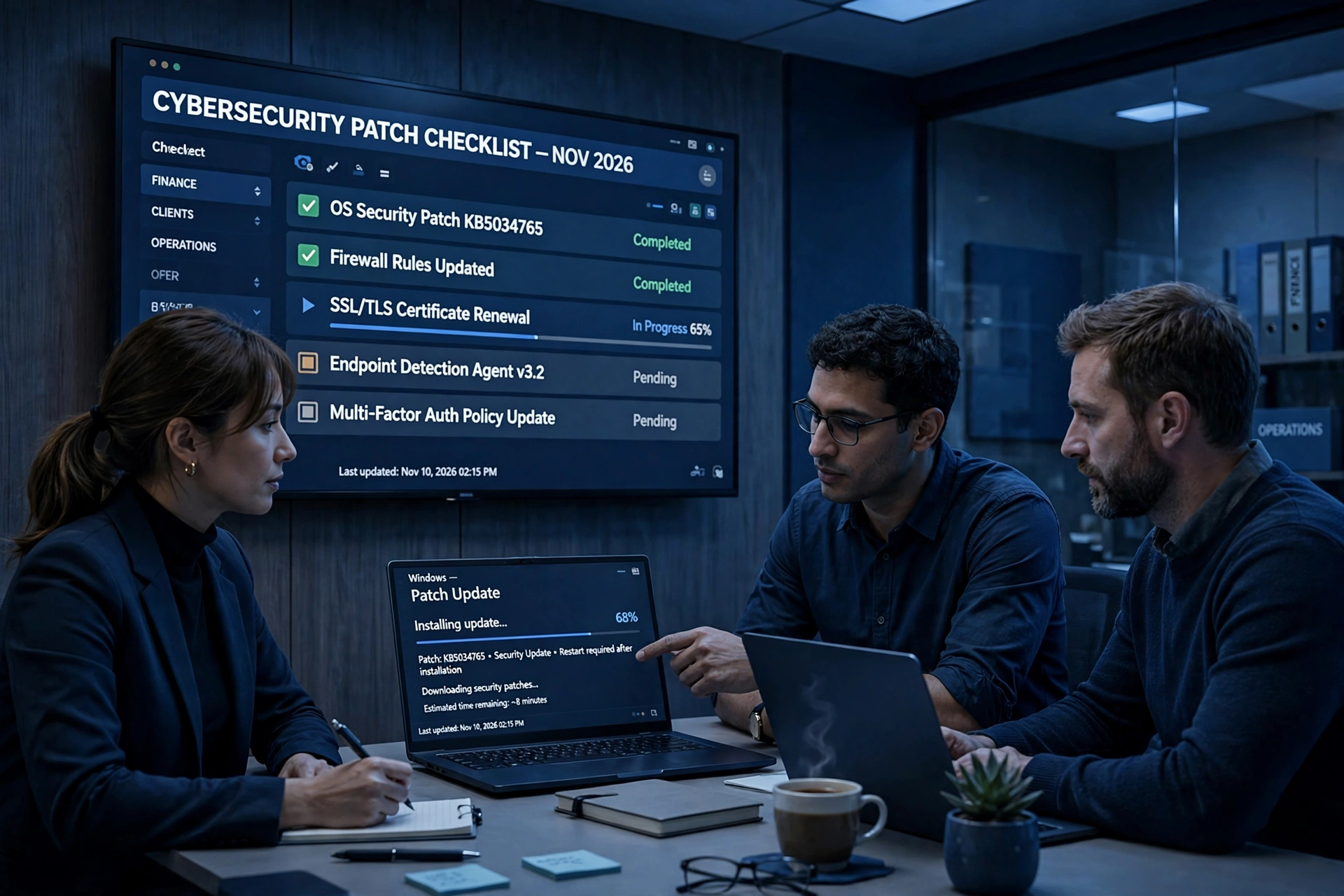
Your 10-Step Checklist
You do not need GPT-6 Cyber to prepare for a world where flaws are found faster. Work through this list with your IT team or your security provider:
- Patch on a schedule. Set a weekly patch window.
- Know what software you run. List the systems, apps, and services you depend on, and who updates each one.
- Turn on multi-factor authentication everywhere it is offered. This one step blocks a large share of account attacks.
- Back up your data, and test the backup. A backup you have never restored is not a backup. Test it at least once a quarter.
- Limit who can install software and change settings. Fewer admin accounts means fewer ways in.
- Ask your vendors how they test and patch. Ask when they last fixed a serious flaw, and how fast they tell customers.
- Run a vulnerability scan, or ask your provider to run one. A regular scan, followed by fixes, is the practical version of the same idea.
- Write down who to call if something goes wrong. A one-page incident plan saves hours in a real incident.
- Train your team on phishing. Short, regular training works better than one long session a year. Our cybersecurity guide for 2026 covers phishing, ransomware, and malware in plain English.
- Review access every few months. Remove accounts for people who have left, and permissions people no longer need.
Hypothetical Example
The following example is fictional, and it is labelled as such so it is not mistaken for a real case. Imagine a small online shop in Ohio with 12 staff. One morning, its website host emails that a serious flaw has been found in the software the shop uses, and a fix is available. The owner, who has a weekly patch window, applies the fix that day. A second shop, using the same software, has no patch schedule and applies the fix three weeks later — while the flaw is public and attackers are scanning for unpatched sites. The difference was not a new AI model. It was a schedule and a habit.
Expert Tips and Best Practices
- Treat every new flaw as a race, not a report. When a serious flaw is disclosed, assume attackers are already looking for unpatched systems. Patch first, ask questions later.
- Prove it before you panic. A working exploit, or a trusted scan result, tells you a flaw is real. A warning without proof should not jump the queue ahead of proved flaws.
- Keep a human in the loop. Whether the tool is an AI agent or a scanner, a person should review high-risk actions before they run, and check the results before they are acted on.
- Disclose responsibly. If you find a flaw in someone else’s software, tell the maintainer privately, with evidence and a proposed fix, and give them time to fix it before you talk about it publicly.
- Do not chase every new model. GPT-6 Cyber is news. A patched system, a tested backup, and a trained team are security. Spend most of your time on the second list.
Common Mistakes to Avoid
- Thinking a Critical rating means your software is at risk right now. The rating describes the model, not your systems. Check your own patch status first.
- Thinking access to the model would solve your security problems. It would help you find flaws faster. It would not fix them, train your staff, or stop phishing.
- Ignoring small flaws because they look minor. OpenAI’s Firefox work showed that 30 known issues were more severe than first thought.
- Testing systems you were not asked to test. Scope is not a formality. Testing outside the agreed scope can break systems and break trust.
- Waiting for a perfect tool. The tools will keep improving. The habits — patching, backing up, limiting access, training staff — are what protect you while you wait.
Conclusion
GPT-6 Cyber is a real step forward: a 48.5% score on ExploitGym, up from 32.1%; 81 new high-severity Firefox flaws found; 948 working Linux kernel exploits built in a controlled campaign; and a 99.93% success rate at staying inside its assigned scope. Those results explain why OpenAI rated the model Critical, and why it limited access to approved Daybreak Red customers. They do not mean the model will solve cybersecurity on its own. GPT-6 Cyber finds flaws and proves they are real. It does not fix them, it does not train your team, and it does not protect you from the simple attacks that still cause most harm. Its value depends on the people around it — the researchers who set its scope, the maintainers who fix what it finds, and the businesses that patch on time.
For most readers, the right response is practical, not dramatic. Patch on a schedule. Know what software you run. Turn on multi-factor authentication. Back up and test the backup. Ask your vendors how they test and fix their products. The teams that will benefit most are the ones that find flaws fast, fix them fast, and tell the right people fast. GPT-6 Cyber can help with the first part. The rest is still up to us.
Frequently Asked Questions
1. Can I buy or download GPT-6 Cyber?
No. It is not sold as a product and there is no public download. Access is through OpenAI’s Daybreak program, initially only for a select group of approved Daybreak Red customers through the API and Codex. No public price was published in the sources read for this article.
2. When will GPT-6 Cyber be available to the public?
OpenAI has not given a firm date. It says access will expand progressively to all Daybreak Red customers soon, and it is expanding Daybreak Blue for defensive work. Treat “soon” as unconfirmed until OpenAI announces a date.
3. Is Firefox safe to use now, after 81 flaws were found?
The flaws were disclosed to Mozilla with proposed patches, and Mozilla began releasing fixes shortly after receiving the reports. That is how responsible disclosure is supposed to work. The practical step for you is simple: update Firefox — and every browser — promptly, and keep automatic updates on.
4. Does GPT-6 Cyber replace a penetration test?
No. It can speed up parts of a test — finding flaws and proving them with working exploits — but it does not replace a human tester who understands your business, sets the scope, checks the results, and writes a report your team can act on. A pentest is a service, not just a tool.
5. How is GPT-6 Cyber different from GPT-6 Astra?
Astra is the mainline GPT-6 model. It supports code review, vulnerability triage, and patch development, but it refuses many offensive security tasks. GPT-6 Cyber is the cyber-specialised version of Astra, trained for vulnerability discovery, exploit development, and web penetration testing, and allowed — inside approved, authorised testing — to do the offensive work Astra refuses.
6. What does the 48.5% ExploitGym score actually mean?
It means that, on that controlled test, GPT-6 Cyber turned a known flaw into a working exploit on a remote target about half the time, up from about a third for GPT-5.6 Cyber (32.1%). It is a big relative jump, and it also means the model failed more than half the time on that test. It is an OpenAI evaluation, not an independent benchmark.
7. Who is in Daybreak Red, and how do I apply?
Daybreak Red is for approved customers doing advanced security research. You apply through OpenAI’s Daybreak program. Access requires identity verification, use restrictions, and, for API access, IP allowlisting by default. OpenAI also runs a $1 billion Daybreak for Frontline Defenders grant program for resource-constrained teams.
8. Will GPT-6 Cyber make my business more secure if I never use it?
Indirectly, yes — if your vendors use it well. When flaws are found faster, vendors can ship fixes faster. Your part is to apply those fixes promptly, keep a list of the software you run, and do the basics in the checklist above. The model finds flaws. You still have to patch them.
9. Is GPT-6 Cyber dangerous?
It is powerful, which is why OpenAI rated it Critical and restricted access. It is built for authorised security research, with safeguards including scope monitoring, IP allowlisting, sandboxing, and human oversight. The risk is dual use: the same ability that helps defenders could help attackers if it were in the wrong hands, which is why access is limited — and why open-weight models with weakened safeguards are a separate concern.
10. What should I do this week, in one sentence?
Set a weekly patch window, turn on multi-factor authentication, and check that your backup actually restores — those three steps do more for most small businesses than any new AI model will this month.